
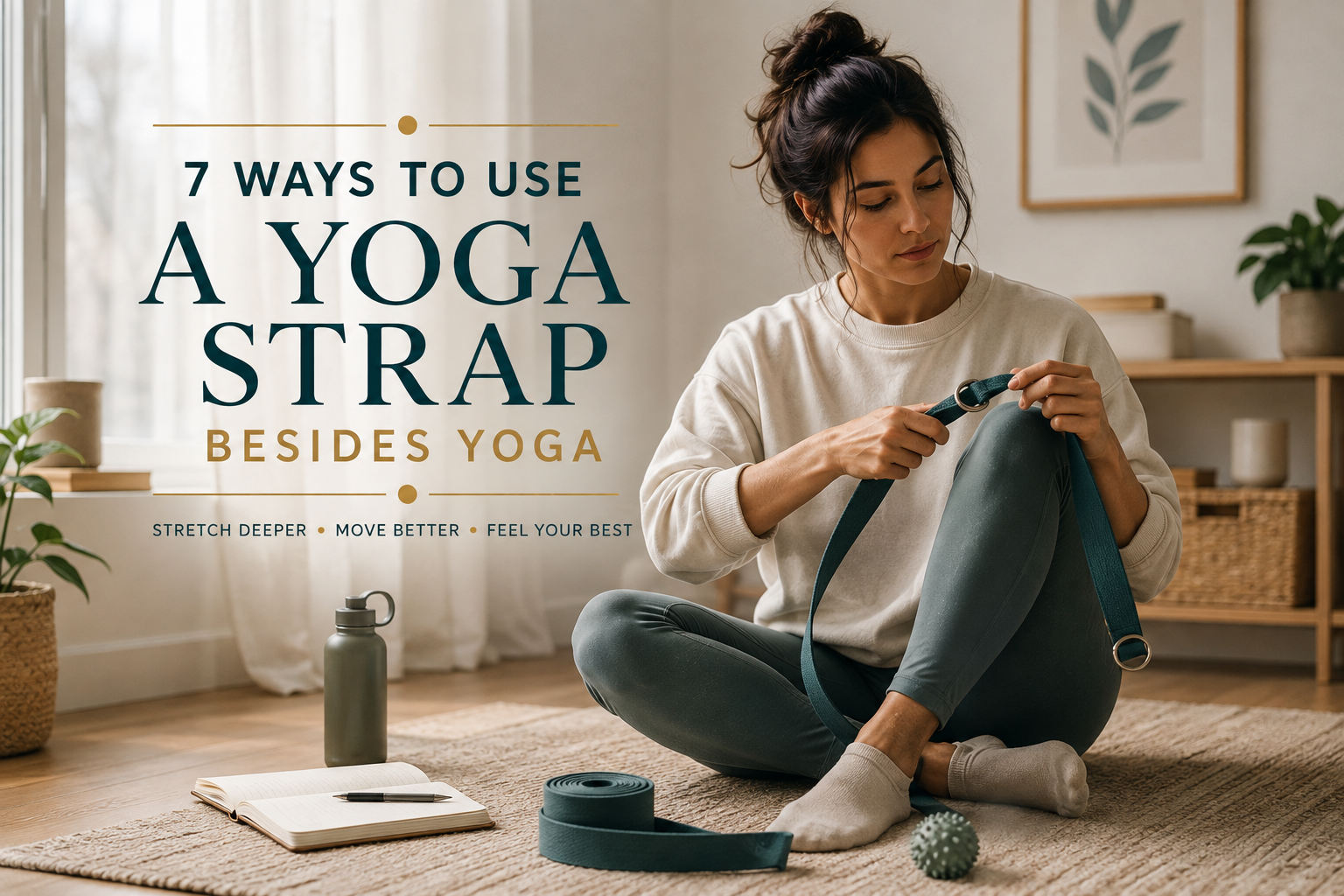
A yoga strap might seem like a piece of equipment reserved for yoga classes, but its simple design makes it useful for much more than traditional yoga poses. A strap can help you reach your feet, improve positioning during stretches, make certain movements more accessible, and add gentle resistance to simple exercises.
You don’t need to be flexible, experienced, or particularly athletic to use one. In fact, a yoga strap can be especially helpful when your range of motion is limited or when you simply want more control over a movement.
Here are seven practical ways to use a yoga strap besides yoga, including how to use it safely and how to choose the right type for your needs.
What Is a Yoga Strap?
A yoga strap is a long, flat strip of fabric, usually made from cotton, nylon, or a similar durable material. Some models have a simple buckle, while others use a sliding or D-ring adjustment system.
The strap doesn’t stretch like a resistance band. Its main purpose is to give you extra reach, positioning, or leverage.
That distinction is important.
A yoga strap isn’t designed to pull your body into a deeper stretch. Instead, it can help you maintain a position without having to force your joints or compensate with other parts of your body.
For example, if you can’t comfortably reach your foot during a hamstring stretch, holding a strap around your foot can give your hands something to hold without requiring you to bend further forward.
1. Use a Yoga Strap for Assisted Stretching
One of the most useful ways to use a yoga strap is as an extension of your arms.
This can make certain stretches easier to perform when your hands cannot comfortably reach the intended position.
Try it with a seated hamstring stretch
- Sit on the floor with one or both legs extended.
- Place the strap around the foot of the extended leg.
- Hold both ends of the strap.
- Sit as upright as comfortably possible.
- Gently draw the strap toward you without pulling aggressively.
- Hold the position while breathing normally.
The goal isn’t to force your torso toward your leg.
Instead, use the strap to maintain a comfortable position while keeping your spine and shoulders relaxed.
Why this can be useful
A strap can provide the extra reach needed to perform a movement without compensating by rounding your back, twisting your body, or straining to reach your foot.
It can also make stretching easier to control because your hands have a stable point of contact.
Tip: If you feel sharp pain, numbness, tingling, or significant discomfort, stop the movement rather than trying to stretch farther.
2. Improve Your Shoulder Mobility
A yoga strap can also be useful for gentle shoulder mobility exercises.
One simple option is a controlled overhead pass-through.
How to do it
- Stand upright and hold the strap with both hands.
- Start with your hands slightly wider than shoulder-width apart.
- Keep your elbows relatively straight.
- Slowly move the strap from in front of your body, overhead, and toward your back.
- Reverse the movement slowly.
- Adjust your hand position if the movement feels too difficult.
If your shoulders are tight, you may need to hold the strap with your hands much farther apart.
That’s perfectly fine.
Wider grip = easier movement.
As your mobility improves, you can gradually experiment with a slightly narrower grip, but there is no requirement to reach a particular position.
Common mistake
Don’t turn this into a competition to see how narrow you can hold the strap.
The purpose is controlled movement, not forcing your shoulders into a larger range of motion.
3. Make Standing Leg Stretches More Accessible
A strap can make standing leg stretches easier when balance or flexibility is the limiting factor.
Instead of trying to grab your foot directly, you can loop the strap around it.
A simple standing variation
- Stand near a wall or sturdy surface if you need additional balance.
- Loop the strap around the sole or forefoot.
- Hold the ends with one or both hands.
- Gently extend the leg to a comfortable position.
- Keep your standing leg stable.
- Maintain the position without pulling aggressively.
This can be particularly useful if reaching your foot requires you to bend, twist, or lose your balance.
Make it easier
You don’t have to raise your leg very high.
A lower leg position is perfectly useful if it allows you to maintain better control and posture.
For beginners, stability is more important than range.
4. Use It to Practice Better Posture and Positioning
A yoga strap can act as a simple tactile cue during certain movements.
For example, you can hold the strap behind your back with both hands to become more aware of your shoulder and upper-body positioning.
It can also be used during seated or standing exercises where you need to maintain a consistent hand position.
The important point is that the strap itself doesn’t “fix” posture.
Instead, it can provide feedback and a physical reference point that makes it easier to notice how you’re positioning your shoulders, arms, and spine.
A simple awareness exercise
Stand comfortably with your feet about hip-width apart.
Hold the strap behind your back with both hands. Keep your shoulders relaxed rather than aggressively pulling them backward.
Take a few slow breaths and notice:
- Are your shoulders creeping toward your ears?
- Are you arching your lower back?
- Are you holding your breath?
- Is one hand much higher than the other?
The purpose is awareness, not forcing your body into a rigid “perfect posture.”
5. Add Gentle Resistance to Simple Exercises
A yoga strap isn’t a substitute for a resistance band, but it can still be useful for creating light resistance or tension during certain exercises.
For example, you can hold the strap between your hands and gently pull outward while performing controlled arm movements.
This creates tension through the strap without requiring heavy equipment.
Important distinction
A traditional yoga strap is generally non-elastic.
A resistance band is designed to stretch and progressively resist movement.
Therefore:
Use a yoga strap for positioning, leverage, and isometric tension.
Use resistance bands when you specifically need elastic resistance.
Trying to use a yoga strap as if it were a resistance band can make an exercise unnecessarily awkward and may damage the strap.
6. Use a Yoga Strap to Make Mobility Exercises Easier
Mobility work isn’t always about stretching farther.
Sometimes the challenge is simply getting into the correct position.
A strap can provide assistance during movements involving the hips, shoulders, ankles, or legs.
For example, during a seated hip mobility exercise, the strap can give you something stable to hold while you concentrate on maintaining your position.
This can be especially useful for beginners who struggle to reach their feet or maintain an upright posture during certain movements.
The key principle
Think of the strap as a tool for positioning, rather than a tool for forcing flexibility.
A good mobility exercise should feel controlled.
You shouldn’t need to yank, bounce, or aggressively pull the strap to make the movement work.
7. Use It for Gentle At-Home Movement Breaks
You don’t need a full workout to use a yoga strap.
It can be kept beside your desk, in a drawer, or in a small home workout area and used for short movement breaks throughout the day.
A five-minute sequence could include:
- shoulder pass-throughs
- seated leg stretches
- gentle hamstring stretches
- standing leg stretches
- controlled arm movements
The advantage is simplicity.
You don’t need a large piece of equipment or a dedicated workout space.
A simple five-minute sequence
Minute 1: Shoulder mobility
Hold the strap with a wide grip and perform slow overhead movements.
Minute 2: Seated hamstring stretch
Use the strap around one foot and maintain a comfortable position.
Minute 3: Switch sides
Repeat on the opposite leg.
Minute 4: Standing leg mobility
Use a wall for balance if necessary.
Minute 5: Gentle full-body movement
Walk around, shake out your arms, and move naturally rather than trying to maximize the stretch.
The goal is simply to interrupt prolonged inactivity with controlled movement.
How to Choose a Yoga Strap for These Uses
You don’t necessarily need an expensive yoga strap.
For most of the uses described above, look for a strap that is:
Long enough for your needs
A longer strap gives you more flexibility when performing shoulder mobility exercises or stretches.
Common yoga straps are available in different lengths, so consider your height, flexibility, and intended use rather than automatically choosing the shortest option.
Comfortable to hold
A strap with a smooth but reasonably grippy surface is generally easier to handle.
If you’re using it for longer stretching sessions, a very rough or stiff material may become uncomfortable.
Easy to adjust
If you plan to create loops, an adjustable buckle or D-ring system can be useful.
A simple strap without adjustment hardware can also work well for basic stretching.
Strong enough for controlled use
Look for durable stitching and hardware that doesn’t feel flimsy.
Remember that a yoga strap is not normally designed to support your entire body weight. Avoid hanging from it, using it as a suspension trainer, or attaching it to unstable objects unless the manufacturer specifically states that the product is designed for that purpose.
Yoga Strap vs. Resistance Band: What’s the Difference?
These two products can look similar, but they serve different purposes.
| Yoga Strap | Resistance Band |
|---|---|
| Usually non-elastic | Elastic |
| Provides extra reach | Provides resistance |
| Useful for positioning | Useful for strengthening exercises |
| Helps maintain stretching positions | Changes resistance as it stretches |
| Good for mobility work | Good for resistance training |
| Usually easier to control for assisted stretching | Better suited to progressive resistance |
If your primary goal is assisted stretching or positioning, a yoga strap is usually the more appropriate tool.
If your goal is strength training, a resistance band is generally the better choice.
Common Yoga Strap Mistakes to Avoid
A yoga strap is simple to use, but a few mistakes can make it less useful.
Pulling too hard
The strap gives you leverage. That doesn’t mean you should use maximum force.
A gentle, controlled tension is usually more appropriate than aggressively pulling yourself into a stretch.
Trying to match someone else’s range of motion
Flexibility varies considerably between individuals.
Your starting position doesn’t need to look like someone else’s.
Locking yourself into an uncomfortable position
If you cannot easily release the strap, the setup is too complicated.
Keep movements simple and make sure you can safely remove the strap at any point.
Using a yoga strap as a resistance band
A non-elastic strap isn’t designed to stretch like a resistance band.
Don’t deliberately pull it beyond its intended use.
Ignoring pain
Stretching can create mild tension, but sharp, burning, or unusual pain is not something you need to push through.
If a movement causes persistent or significant pain, stop and consider discussing it with a qualified healthcare professional.
Do You Need a Yoga Strap?
Not necessarily.
Many of these movements can be performed without equipment.
The value of a yoga strap is that it can make certain positions more accessible, easier to control, or more comfortable.
It can be particularly useful if:
- your hands don’t comfortably reach your feet;
- you’re working on mobility;
- you want more control during stretching;
- you prefer gentle at-home movement;
- you need a simple tool for short movement breaks.
You don’t need to be a yoga practitioner to benefit from one.
Final Thoughts
A yoga strap is a surprisingly versatile piece of equipment. Its biggest advantage isn’t that it makes you stretch farther—it gives you more control over how you move.
You can use it to assist stretches, explore shoulder mobility, improve positioning, add light isometric tension, and create simple movement breaks without needing a full home gym.
The best approach is to start with movements that feel comfortable and controlled. Use the strap to make an exercise more accessible, not to force your body into a position it isn’t ready for.
And if you’re deciding whether to buy one, focus less on branding and more on the basics: appropriate length, comfortable material, durable construction, and an adjustment system that suits the way you plan to use it.