
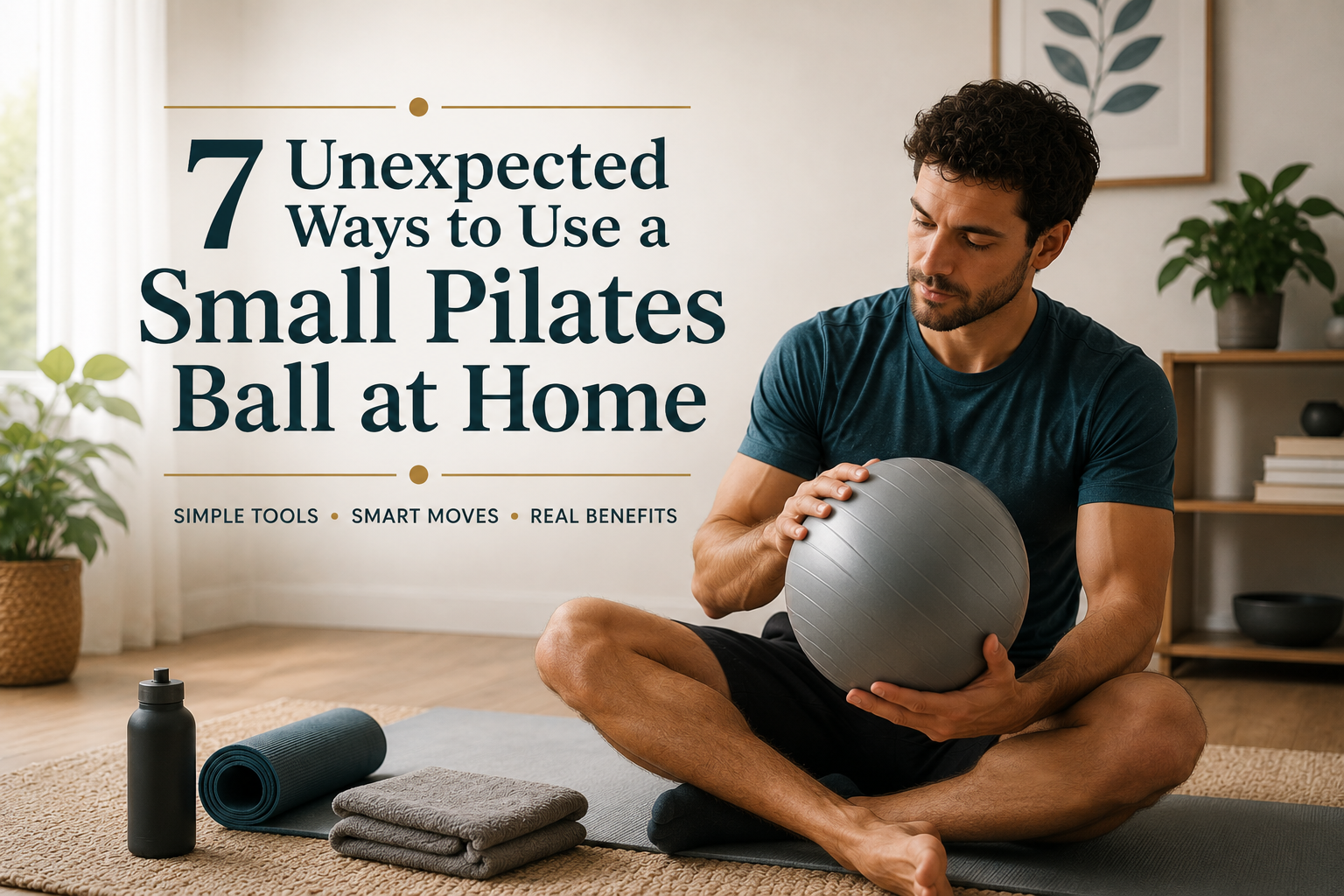
A small Pilates ball is easy to underestimate. Often associated with Pilates classes and core exercises, this lightweight, inflatable ball can actually be useful for mobility work, posture awareness, balance exercises, stretching, and simple movement breaks at home.
You don’t need a Pilates routine or a dedicated workout space to use one. Its small size makes it particularly convenient for people who want to add more movement to their day without filling their home with exercise equipment.
The key is understanding what the ball is designed to do. A small Pilates ball provides an unstable or supportive surface depending on how you use it. That can make familiar movements more challenging, or help you position your body more comfortably.
Here are seven practical ways to put one to work.
What Is a Small Pilates Ball?
A small Pilates ball is typically an inflatable, soft exercise ball measuring roughly 20–30 cm (8–12 inches) in diameter, although sizes vary by manufacturer.
Unlike a large stability ball, it isn’t primarily designed for sitting or supporting your full body weight.
Instead, it can be:
- placed between your knees or thighs;
- positioned behind your back;
- used underneath a limb;
- held between your hands;
- incorporated into controlled movement exercises.
Because the ball can compress and change shape slightly under pressure, it can provide tactile feedback and alter the mechanics of familiar exercises.
Before using yours, check the manufacturer’s recommended inflation level and weight limits. Never use a damaged ball or one that is inflated beyond its stated specifications.
1. Use It as a Support During Floor Exercises
One of the simplest uses is using the ball as a small support.
For example, when lying on your back, you can place the ball underneath your knees or between your knees depending on the exercise.
This changes your positioning and can make certain floor movements feel more comfortable.
Try this simple setup
- Lie comfortably on your back.
- Bend your knees.
- Place the ball underneath your knees.
- Let your legs rest naturally on the ball.
- Spend a few minutes breathing normally and noticing how the position feels.
You don’t need to perform a complicated exercise.
The ball can simply be used as a positioning tool while you become familiar with different body positions.
Tip: The ball should feel stable enough for you to relax. If it rolls unexpectedly, reduce the amount of pressure or choose a different position.
2. Use It Between Your Knees for Controlled Movement
A small Pilates ball can also provide a physical reference point between your knees or thighs.
This is useful during simple exercises where you want to maintain consistent leg positioning.
For example, during a basic bridge:
- Lie on your back with your knees bent.
- Place the ball gently between your thighs.
- Keep your feet comfortably on the floor.
- Maintain light, even contact with the ball.
- Slowly lift your hips.
- Lower yourself with control.
The goal isn’t to crush the ball.
Instead, use just enough pressure to keep it in place.
This can make you more aware of whether your knees are moving dramatically inward or outward during the exercise.
Why this is useful
The ball gives you immediate tactile feedback.
If you squeeze it aggressively, you’ll know you’re using unnecessary force. If it falls, you may have lost your positioning.
That feedback can make a simple exercise more deliberate.
3. Turn It Into a Balance Challenge
Small Pilates balls can also make familiar movements slightly less predictable.
You can incorporate the ball into simple balance exercises, but start with movements that keep at least one foot firmly on the ground.
Beginner-friendly option
Stand near a wall or sturdy piece of furniture.
Hold the ball in both hands and slowly move it:
- from side to side;
- overhead and back down;
- from chest height toward one hip;
- in small circles.
Your feet remain planted while your upper body moves.
This introduces an additional coordination challenge without requiring you to stand on the ball or perform advanced balance exercises.
Progress gradually
Once you’re comfortable, you can experiment with changing your stance, such as bringing your feet slightly closer together.
Don’t rush into single-leg exercises simply because the movement looks easy.
Balance is highly individual, and having a stable surface nearby is a sensible precaution.
4. Use It for Seated Posture Awareness
A small Pilates ball can be useful for becoming more aware of your seated position.
Rather than using it as a permanent replacement for an ergonomic chair, you can use the ball briefly as a movement and awareness tool.
For example, sit on a firm chair and hold the ball lightly between your hands.
As you sit, notice:
- whether your shoulders are relaxed;
- whether you’re leaning heavily to one side;
- whether your head is consistently positioned far forward;
- whether you’re holding unnecessary tension.
You can then change positions deliberately and notice how different positions feel.
An important distinction
A Pilates ball does not automatically correct posture.
There is no single position that everyone needs to maintain all day.
For most people, regularly changing position and avoiding prolonged static postures is more practical than trying to maintain one rigid “perfect posture.”
5. Use It for Gentle Mobility Work
The ball can also be incorporated into simple mobility movements.
For example, you can hold it with both hands while performing controlled torso rotations.
Try this seated movement
- Sit comfortably with your feet on the floor.
- Hold the ball with both hands at chest height.
- Keep your movement slow and controlled.
- Rotate your torso gently toward one side.
- Return to the center.
- Repeat on the opposite side.
Keep the range of motion comfortable.
The purpose isn’t to rotate as far as possible. You’re simply using the ball to give your hands a clear reference point while moving.
You can also use the ball during gentle shoulder and arm movements.
Because the ball is visually obvious and easy to hold, it can make simple mobility work feel more structured.
6. Make Short Movement Breaks More Interesting
You don’t need a 45-minute workout to use a Pilates ball.
One of its biggest advantages is that it can turn a few minutes of movement into something more engaging.
Keep the ball somewhere visible rather than hidden in a closet.
During a break from work, try a short sequence:
A 5-minute Pilates ball break
Minute 1: Hold the ball overhead and bring it slowly back down.
Minute 2: Perform gentle torso rotations while holding the ball.
Minute 3: Place the ball between your thighs and perform several controlled seated or standing movements.
Minute 4: Practice simple standing balance while holding the ball.
Minute 5: Walk around and move naturally.
The objective isn’t to maximize calorie burn or turn every break into a workout.
It’s simply to interrupt long periods of sitting with some intentional movement.
7. Use It to Make Familiar Exercises More Challenging
A small Pilates ball can also add an extra coordination element to exercises you already know.
For example, you can hold it between your hands during squats or lunges.
Instead of simply performing the movement, you now have to maintain control of the ball while coordinating your arms and legs.
You can also use it during basic floor exercises to create an additional positioning challenge.
Start with familiar movements
This is important.
Don’t introduce an unstable object into an exercise you haven’t learned yet.
First learn the movement without the ball.
Then add the ball once you understand the basic technique.
This approach makes it easier to identify whether the ball is actually helping or simply making the exercise unnecessarily complicated.
How to Choose the Right Small Pilates Ball
If you’re buying one, you don’t necessarily need the most expensive model.
Pay attention to a few practical characteristics.
Size
Small Pilates balls are commonly around 20–30 cm (8–12 inches), but the appropriate size depends on how you intend to use the ball.
A ball used between the thighs may have different requirements from one used as a support during floor exercises.
Check the manufacturer’s recommended applications before purchasing.
Material
Look for a durable, skin-friendly material that doesn’t feel excessively slippery.
PVC and similar synthetic materials are common.
If you plan to use the ball directly against your skin, texture can matter more than appearance.
Inflation
An adjustable inflation level can be useful.
A softer ball can behave differently from a firmer one, so being able to adjust the amount of air gives you more control over how the ball feels.
However, never exceed the manufacturer’s recommended inflation level.
Surface texture
A slightly textured surface can make the ball easier to control.
This can be particularly helpful during movements where you are holding the ball or placing it against another part of your body.
Pump
Some products include a pump, while others don’t.
If the ball requires frequent inflation adjustments, having a compatible pump nearby can be convenient.
Small Pilates Ball vs. Large Stability Ball
These products aren’t interchangeable.
| Small Pilates Ball | Large Stability Ball |
|---|---|
| Compact | Requires considerably more space |
| Usually used for positioning and controlled exercises | Can support larger portions of the body |
| Easy to store | Needs dedicated storage space |
| Useful for floor-based exercises | Often used for seated or full-body exercises |
| Generally easier for beginners to handle | Requires more space and balance awareness |
If you live in a small apartment or simply don’t want bulky equipment, a small Pilates ball can be a more practical option.
Common Mistakes to Avoid
A few simple precautions can make the ball much easier to use.
Overinflating the ball
More air doesn’t necessarily mean better performance.
Follow the manufacturer’s instructions.
Using furniture that isn’t stable
If you’re using a chair, wall, or other object for balance, make sure it can safely support you.
Avoid lightweight tables or furniture that can slide.
Treating the ball like a toy
Don’t sit, stand, or jump on a small Pilates ball unless the manufacturer specifically states that it is designed for that purpose.
Starting with difficult balance exercises
There’s no benefit in making an exercise unnecessarily risky.
Start with both feet on the floor and progress gradually.
Using the ball through pain
A movement should not cause sharp or unusual pain.
If an exercise causes significant discomfort, stop and reassess the movement. Persistent or concerning pain should be discussed with an appropriate healthcare professional.
Do You Actually Need a Pilates Ball?
No.
A small Pilates ball is a tool, not a requirement for mobility or exercise.
Many of the movements described above can be performed without equipment.
The ball becomes useful when you want:
- a simple tactile cue;
- additional support;
- a positioning aid;
- a coordination challenge;
- a compact piece of equipment for home use;
- more variety in short movement breaks.
Its biggest advantage is versatility rather than complexity.
You can store it in a drawer, closet, or small corner and pull it out whenever you want to add something different to your movement routine.
Final Takeaway
A small Pilates ball can do considerably more than its name suggests.
You can use it as a support during floor exercises, a positioning tool, a tactile cue, a balance challenge, or a simple way to make short movement breaks more engaging.
The most useful approach is to start with simple applications and gradually experiment with more challenging movements as your familiarity increases.
You don’t need a dedicated Pilates studio, an extensive home gym, or an elaborate routine. Sometimes a small, inexpensive piece of equipment is enough to make everyday movement a little more varied and intentional.