
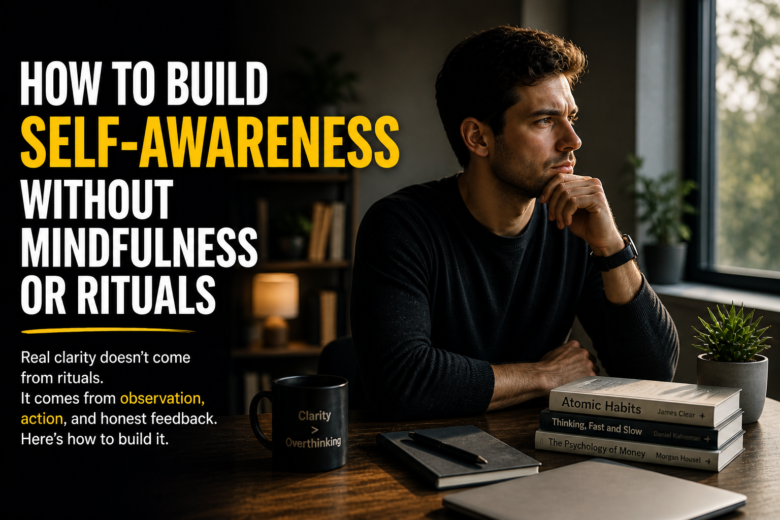
There’s a growing assumption that self-awareness requires specific practices. Meditation, journaling, mindfulness routines—these are often presented as the only valid paths to understanding yourself. But for many people, especially those who think analytically, these methods feel abstract, inconsistent, or disconnected from real life.
The result is frustration. You try to follow structured practices, but they don’t produce clear insights. Instead of clarity, you get more questions. Instead of direction, you get ambiguity. It starts to feel like self-awareness is something reserved for people who can engage deeply with introspection in a very specific way.
Understanding How to Build Self-Awareness Without Mindfulness or Rituals offers a different approach. One that is grounded in behavior, feedback, and observable patterns. If you’ve been searching for clarity through reflection alone, this framework shifts the process toward something far more practical and reliable.
Why Self-Awareness Feels Complicated Today
Modern life creates constant cognitive noise. You are exposed to endless perspectives, advice, and interpretations about who you should be. This creates a subtle but persistent fragmentation.
Instead of forming a stable understanding of yourself, you adapt continuously to external inputs. Your sense of identity becomes reactive rather than structured.
This is not a failure of discipline. It is a consequence of operating in an environment with too many variables and not enough filters.
Self-awareness requires coherence. Without it, your perception of yourself becomes unstable.
The Myth of Needing Mindfulness or Rituals
There is a widespread belief that awareness comes from slowing down and looking inward.
While introspection can be useful, it is not sufficient on its own. The mind, when isolated from external input, tends to recycle existing narratives. You reflect using the same framework that already limits your understanding.
Rituals can create consistency, but they do not guarantee accuracy.
Without interaction with reality, reflection becomes circular.
Self-awareness is not about observing your thoughts in isolation. It is about understanding how your thoughts translate into behavior and outcomes.
Self-Awareness as a System, Not a Practice
To understand How to Build Self-Awareness Without Mindfulness or Rituals, you need to shift your perspective.
Self-awareness is not a single activity. It is a system.
A system consists of inputs, processes, and outputs. In this context, your actions are inputs, your interpretation is the process, and your results are outputs.
Awareness emerges when you observe the relationship between these elements over time.
This approach removes the need for abstract techniques. Instead, it focuses on observable dynamics.
How to Build Self-Awareness Without Mindfulness or Rituals
The process is not complex, but it requires consistency.
You are not trying to understand yourself through isolated thinking. You are building a system that reveals your patterns through interaction.
Each step reinforces the next.
Step 1: Observe Behavior, Not Thoughts
Thoughts are unstable. They change based on context, mood, and external influence.
Behavior is measurable.
What you do consistently reveals more about you than what you think occasionally. Actions expose priorities, even when those priorities are not consciously defined.
By focusing on behavior, you move from interpretation to observation.
This creates a more reliable foundation for awareness.
Step 2: Use Feedback Instead of Reflection
Reflection is subjective. Feedback is grounded in outcomes.
Every decision produces a result. That result provides information.
Instead of asking whether something felt right, you evaluate whether it worked.
In the middle of this process, How to Build Self-Awareness Without Mindfulness or Rituals becomes practical. You are no longer relying on internal guesses. You are analyzing real data generated by your own actions.
This shift increases clarity significantly.
Step 3: Identify Patterns Over Time
Single experiences are misleading.
Patterns are not.
When you notice repeated behaviors and consistent outcomes, you begin to see structure. These patterns reveal how your internal system operates under different conditions.
They show where your attention naturally goes, what you avoid, and what you sustain over time.
Awareness emerges from repetition.
Step 4: Test and Adjust Decisions
Understanding alone is not enough.
You need to test your assumptions.
When you adjust your decisions and observe the results, you refine your understanding. This creates a feedback loop where awareness evolves continuously.
You are not defining yourself. You are calibrating your behavior.
This dynamic process prevents stagnation.
Step 5: Build Internal Consistency
Consistency stabilizes awareness.
When your actions align with observed patterns, your internal system becomes more predictable. This reduces friction in decision-making.
You no longer rely on guesswork. You rely on evidence.
Over time, this creates a sense of clarity that is grounded, not abstract.
Environmental Influence on Awareness
Your environment shapes your behavior.
Different contexts produce different responses. If you only operate within a limited environment, your understanding will also be limited.
Exposure expands awareness.
By interacting with varied situations, you generate more data. This allows you to identify which patterns remain consistent regardless of context.
Those stable patterns are the foundation of self-awareness.
Common Cognitive Distortions
Several distortions interfere with this process.
Overthinking replaces action, preventing feedback from being generated.
Emotional reasoning prioritizes temporary feelings over consistent patterns.
Comparison introduces external standards that distort internal clarity.
These distortions are predictable. Recognizing them allows you to maintain focus on observable dynamics rather than subjective interpretation.
Long-Term Integration
As the system develops, awareness becomes more stable.
You begin to trust patterns rather than impressions. Decisions become clearer because they are based on repeated observation.
At this stage, How to Build Self-Awareness Without Mindfulness or Rituals is no longer something you consciously apply. It becomes part of how you operate.
You are no longer trying to understand yourself.
You are observing a system that you have already built.
Conclusion
Self-awareness does not require rituals. It does not depend on specific practices or abstract techniques.
It emerges from interaction, observation, and consistency.
By applying How to Build Self-Awareness Without Mindfulness or Rituals, you shift from passive reflection to active understanding. You stop searching for clarity internally and start generating it through behavior and feedback.
Over time, this creates a stable, reliable sense of who you are—not as an idea, but as a pattern.
FAQs
1. Can I develop self-awareness without any introspection?
Yes. Behavior and feedback provide more accurate insights than introspection alone.
2. Why don’t mindfulness practices work for everyone?
Because they rely heavily on subjective interpretation, which varies significantly between individuals.
3. How long does it take to build self-awareness?
Initial patterns can appear quickly, but stability requires consistent observation over time.
4. What is the biggest mistake in this process?
Relying on thoughts instead of behavior as the primary source of insight.
5. Can this method replace traditional self-development practices?
It doesn’t replace them—it reframes them into a more practical system.