
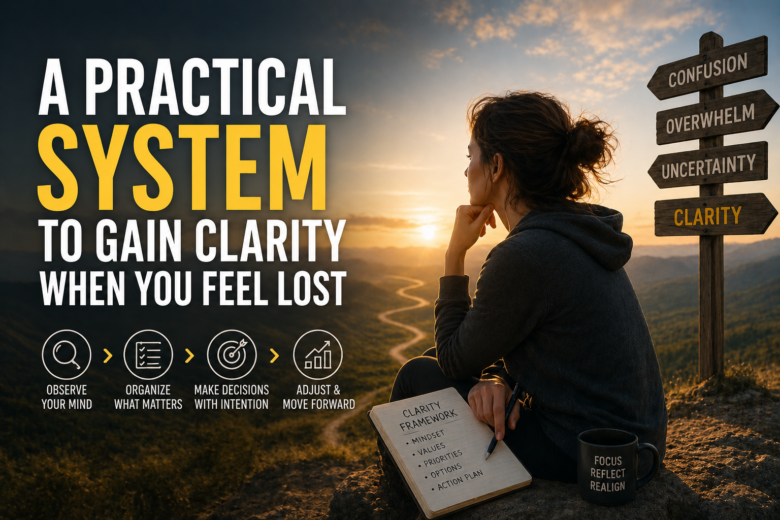
Modern life creates an unusual psychological condition: people have more information, more options, and more autonomy than ever before, yet they often feel more uncertain about their direction. This is not a contradiction in intelligence, but a structural issue in how the mind processes complexity without stable external frameworks.
For individuals who are skeptical of traditional belief systems, this uncertainty becomes even more pronounced. Without inherited answers, every decision must be constructed from internal reasoning rather than external instruction. This creates both freedom and cognitive overload, especially in high-performance environments where clarity is expected but rarely taught.
In this context, developing A Practical System to Gain Clarity When You Feel Lost becomes less about motivation and more about engineering a reliable internal decision architecture that can operate under uncertainty without collapsing into confusion.
A Practical System to Gain Clarity When You Feel Lost: Building Internal Structure
The phrase A Practical System to Gain Clarity When You Feel Lost is not about finding a single insight or breakthrough moment. It refers to constructing a repeatable cognitive process that reduces ambiguity over time.
Clarity is not an emotion. It is a byproduct of structured interpretation. When inputs are disorganized, outputs feel chaotic. When inputs are structured, decisions begin to stabilize. The goal is not to eliminate uncertainty, but to organize it into something navigable.
This shift requires moving away from reactive thinking and toward system-based thinking, where internal experience is treated as something that can be mapped, analyzed, and refined.
Why Modern Minds Feel Chronically Lost
Feeling lost is often misinterpreted as a personal failure, but in reality it is a predictable outcome of cognitive overload. The human brain evolved for environments with limited variables. Modern environments contain exponential informational complexity.
Digital exposure, social comparison loops, and constant context switching fragment attention. Over time, this reduces the brain’s ability to maintain coherent internal narratives. Without coherence, decision-making feels unstable.
Research on cognitive load theory explains how working memory limitations affect decision clarity: https://www.simplypsychology.org/cognitive-load.html
When every input competes for attention, the result is not insight but fragmentation. This is the environment in which many people attempt to build life direction.
The Illusion of External Direction
One of the most persistent cognitive traps is the belief that clarity should come from outside sources—career frameworks, social validation, or ideological systems.
While external structures can temporarily reduce uncertainty, they often fail to adapt to individual complexity. Overreliance on them creates dependency rather than clarity.
At some point, individuals begin to realize that no external system fully accounts for their internal variability. This realization is often disorienting, but it is also necessary. It forces the development of internal reasoning structures.
This is where A Practical System to Gain Clarity When You Feel Lost becomes relevant—not as a philosophy, but as a replacement for borrowed certainty.
Rebuilding Internal Cognitive Structure
To regain clarity, the first step is not action but structure. The mind must be treated as a system with inputs, processing layers, and outputs.
Inputs include sensory experience, memory recall, and environmental triggers. Processing includes interpretation, bias filtering, and emotional tagging. Outputs include decisions, behaviors, and attention allocation.
Most confusion arises when these layers are not distinguished. Thoughts feel like truths, emotions feel like directives, and impulses feel like identity.
Once these layers are separated conceptually, clarity begins to emerge naturally because noise is no longer interpreted as meaning.
Mapping Thoughts, Emotions, and Decisions
A practical approach to internal clarity involves mapping recurring mental patterns. Not in a superficial journaling sense, but as structural observation.
For example, certain thoughts consistently precede anxiety. Certain environments consistently reduce focus. Certain interactions consistently increase internal conflict.
When these relationships are observed over time, the internal system begins to reveal predictable patterns. Predictability is the foundation of control.
At this stage, A Practical System to Gain Clarity When You Feel Lost becomes operational rather than theoretical. It shifts from idea to applied cognition.
Probabilistic Thinking for Real-Life Clarity
Clarity does not come from certainty. It comes from structured probability estimation.
Instead of asking “What is the right decision?”, a more functional question is “What is the most likely outcome given current information?”
E[X]=∑pixi
This framework allows decisions to be evaluated in terms of expected value rather than emotional intensity. It reduces the cognitive distortion caused by fear, optimism, or social pressure.
In practice, this means replacing binary thinking with distribution-based thinking. Most real-world outcomes are not certain; they are probabilistic.
Emotional Noise vs Informational Signal
One of the most important distinctions in A Practical System to Gain Clarity When You Feel Lost is separating emotional intensity from informational relevance.
Emotions are not errors. They are data points. However, they are not always reliable indicators of truth. High emotional intensity often amplifies perceived importance without increasing accuracy.
Learning to distinguish between emotional noise and actionable information is a core cognitive skill. It allows individuals to respond to reality rather than internal amplification loops.
Neuroscience research on emotional regulation supports this distinction: https://www.ncbi.nlm.nih.gov/pmc/articles/PMC5573560/
Designing a Personal Decision System
Once internal patterns are visible, they can be structured into a decision system.
A functional system typically includes:
- Defining the decision clearly
- Identifying constraints and trade-offs
- Estimating outcomes under uncertainty
- Evaluating long-term consequences
- Tracking results for feedback loops
Over time, this creates a personal cognitive model that improves with use. The system becomes more accurate not through intuition, but through iteration.
This is where A Practical System to Gain Clarity When You Feel Lost transitions from introspection into applied design.
Common Mental Traps That Increase Confusion
There are predictable cognitive errors that prevent clarity from forming.
One is over-analysis, where thinking replaces observation. Another is identity fusion, where temporary states are mistaken for permanent traits. A third is avoidance of uncertainty, which leads to premature decisions designed to eliminate discomfort rather than solve problems.
These patterns are not signs of weakness. They are default modes of the human cognitive system under stress.
Recognizing them is not enough; they must be actively accounted for in decision design.
How Clarity Evolves Over Time
Clarity is not a static state. It is a dynamic process that improves through feedback and correction.
As internal mapping improves, decisions become faster and less emotionally charged. This does not mean life becomes simpler, but that complexity becomes more structured.
Over time, individuals begin to trust their own reasoning not because it is perfect, but because it is consistent and self-correcting.
In this stage, A Practical System to Gain Clarity When You Feel Lost becomes less about solving confusion and more about maintaining coherence under changing conditions.
Conclusion
Clarity is not something found externally or achieved once. It is constructed through repeated cycles of observation, interpretation, and adjustment.
When internal experience is treated as a system rather than a mystery, confusion becomes manageable. Decisions become structured. Emotional noise becomes distinguishable from informational signal.
Ultimately, A Practical System to Gain Clarity When You Feel Lost is not about eliminating uncertainty but about building the capacity to operate effectively within it. That shift is what transforms confusion into navigable complexity.
FAQs
1. Is clarity something you can permanently achieve?
No. It is a dynamic state that requires continuous maintenance and updating.
2. Do I need technical knowledge for this system?
No. It relies more on structured observation than technical skill.
3. Can emotions be ignored in decision-making?
No. They must be interpreted as signals, not ignored or obeyed blindly.
4. How long does it take to develop clarity?
It varies, but pattern recognition typically emerges through consistent reflection over time.
5. What is the first practical step?
Begin observing recurring mental patterns without attempting to immediately change them.