
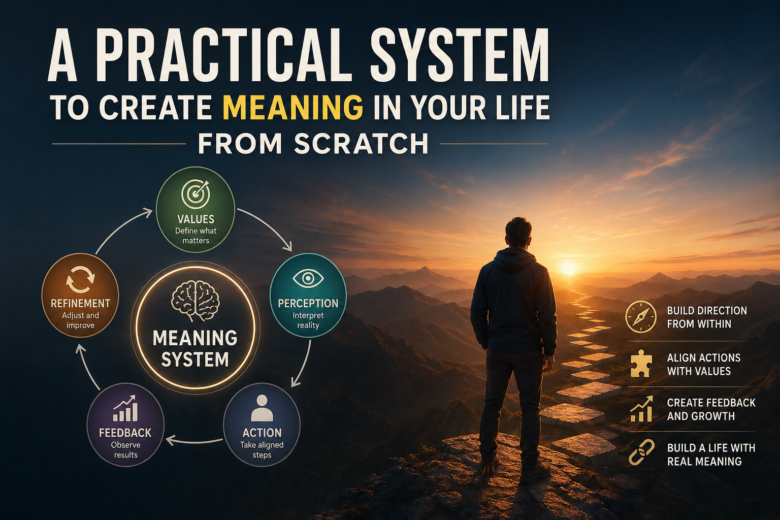
There is a quiet shift happening beneath the surface of modern life. People are no longer inheriting meaning in the way previous generations did. Religion, tradition, and rigid social roles once provided a ready-made framework for purpose. Today, those structures have weakened, especially among individuals who prioritize logic, autonomy, and evidence over belief systems. What remains is not emptiness, but an open question most people were never trained to answer.
The result is a specific kind of psychological friction. You are capable, informed, and self-aware, yet something feels undefined. Not dramatically broken, just subtly unclear. This is often misinterpreted as a lack of direction or motivation, when in reality it is a structural gap: the absence of a system for generating meaning internally.
Understanding A Practical System to Create Meaning in Your Life From Scratch is not about adopting new beliefs or chasing abstract fulfillment. It is about building a framework that allows meaning to emerge from your own cognition and behavior. If you have ever felt that purpose should make sense before it feels meaningful, this is where that process begins to take shape.
A Practical System to Create Meaning in Your Life From Scratch: A Rational Approach
Most people approach meaning as if it already exists somewhere, waiting to be discovered. This assumption is deeply embedded in cultural narratives. You are supposed to “find your purpose,” as if it were a hidden object rather than a constructed outcome. The problem with this model is that it creates passivity. You wait instead of build.
A rational approach starts from a different premise. Meaning is not discovered—it is generated. It emerges from the interaction between your internal system and your external environment. This means that instead of searching for a predefined answer, you are designing a process.
In this sense, A Practical System to Create Meaning in Your Life From Scratch is not philosophical. It is operational. It asks a more useful question: what patterns of thinking and behavior consistently produce a sense of meaning over time?
Why Meaning Feels Absent in Modern Life
To understand why meaning feels elusive, you need to examine the environment in which your mind operates. Modern life is defined by abundance—of information, options, and perspectives. While this seems beneficial, it creates a paradox. More options increase complexity, and complexity reduces clarity.
Your cognitive system is not optimized for infinite choice. It is optimized for constrained environments where decisions are limited and feedback is immediate. When those constraints disappear, the system begins to fragment. Attention becomes scattered, priorities become unstable, and meaning becomes diluted.
This is not a personal failure. It is a predictable outcome of operating without structure. Without a framework to filter information and guide behavior, the mind defaults to short-term signals: distraction, novelty, and emotional fluctuation.
Meaning requires coherence. Without it, even productive activity can feel directionless.
The Illusion of “Finding” Meaning
The idea that meaning must be found creates a subtle but powerful problem. It implies that meaning exists independently of your actions. This leads to a search-based mindset, where you constantly evaluate whether something “feels right” instead of building something that becomes right over time.
In practice, this results in hesitation. You delay commitment because you are waiting for certainty. You analyze options endlessly because you assume the correct one must exist.
But meaning does not precede action. It follows it.
When you engage deeply with something—whether it is work, relationships, or skill development—you create conditions for meaning to emerge. Without engagement, meaning has no substrate to attach to.
This is why purely reflective approaches often fail. Thinking about meaning does not generate it. Interaction does.
Meaning as a Constructed System
To apply A Practical System to Create Meaning in Your Life From Scratch, you have to reframe meaning as a system rather than a concept.
A system has inputs, processes, and outputs. In this context, inputs include experiences, environments, and information. Processes include interpretation, emotional response, and decision-making. Outputs include behavior, results, and feedback.
Meaning emerges when these components align consistently over time.
For example, when your actions reflect your internal priorities and produce outcomes that reinforce those priorities, the system stabilizes. That stability is experienced subjectively as meaning.
This removes the need for abstract definitions. Meaning is not something you define once. It is something you observe as a pattern.
Internal Variables: Values, Perception, Identity
Three internal variables play a critical role in this system: values, perception, and identity.
Values determine what you consider important. They act as filters, prioritizing certain outcomes over others. Without clearly defined values, all options feel equally uncertain, which leads to indecision.
Perception determines how you interpret reality. Two people can experience the same situation and derive completely different meanings from it. This is not randomness—it is the result of different cognitive models.
Identity determines how you position yourself within your own system. If your identity is unclear or inconsistent, your behavior will reflect that instability.
These variables are not fixed. They evolve through interaction with the environment. The goal is not to define them perfectly, but to observe how they operate and refine them over time.
Action, Feedback, and Reinforcement Loops
Meaning becomes tangible through feedback loops. When you act, you generate results. Those results produce feedback. That feedback influences future behavior.
If the loop is coherent, meaning increases. If the loop is inconsistent, meaning decreases.
For example, if you pursue a goal that aligns with your values and you see measurable progress, the brain reinforces that behavior. Over time, this creates a sense of direction and purpose.
If, on the other hand, your actions are disconnected from your values or produce no meaningful feedback, the system destabilizes. You begin to question not just the activity, but your overall direction.
Understanding this loop is essential because it shifts the focus from abstract meaning to observable dynamics. You are no longer asking what matters in theory. You are observing what creates stability in practice.
Designing a Repeatable Meaning System
At this point, A Practical System to Create Meaning in Your Life From Scratch becomes a design problem.
You need a system that consistently produces alignment between what you do and what you value.
This does not require complexity. It requires consistency.
You define a small set of priorities, align your actions with those priorities, observe the results, and adjust based on feedback.
Over time, this creates a closed loop where behavior reinforces meaning and meaning reinforces behavior.
The key is iteration. The system does not need to be perfect. It needs to be adaptable.
Cognitive Traps That Destroy Meaning
There are several predictable failure points in this process.
One of the most common is overthinking. Instead of acting, you attempt to resolve uncertainty through analysis. This creates a loop where no action is taken, and therefore no feedback is generated.
Another trap is comparison. When you measure your progress against others, you introduce external variables that distort your internal system. Meaning becomes dependent on relative performance rather than intrinsic alignment.
A third trap is inconsistency. Sporadic effort prevents feedback loops from stabilizing. Without repetition, patterns cannot form.
These traps are not random. They are default responses when the system lacks structure. Recognizing them allows you to design around them.
Long-Term Integration and Stability
As the system matures, meaning becomes less volatile. It no longer depends on constant validation or emotional intensity. Instead, it stabilizes as a background condition.
This does not mean life becomes predictable. It means your response to variability becomes more consistent.
You begin to trust the system because you have observed it working over time. Decisions become clearer, not because they are easier, but because they are aligned with a structure you understand.
In this stage, meaning is no longer something you question daily. It becomes an emergent property of how you operate.
Conclusion
Meaning does not need to be given to exist. It does not need to be discovered to be valid. When you understand A Practical System to Create Meaning in Your Life From Scratch, you realize that meaning is not a static answer but a dynamic process shaped by your actions, your perception, and your ability to refine both over time.
What changes is not the external world, but your relationship to it. Instead of searching for purpose, you begin to generate it through consistent interaction with reality. That shift is what transforms uncertainty into direction and activity into meaning.
FAQs
1. Can meaning really be created without any belief system?
Yes. Meaning emerges from behavioral consistency and internal coherence, not belief.
2. Why does life feel empty without structure?
Because the brain relies on patterns. Without them, interpretation becomes unstable.
3. How long does it take to build meaning?
It depends on consistency. Feedback loops can begin forming quickly with repeated action.
4. Is meaning the same as purpose?
They overlap, but meaning is the experience, while purpose is the direction.
5. What is the first practical step?
Start aligning daily actions with one clearly defined priority and observe the results.