Most people assume that finding a spiritual path requires belief. Not just any belief, but belief in something intangible—religion, energy, or a higher force. For a skeptical mind, this creates immediate resistance. It does not feel grounded, testable, or logically consistent.
Because of this, many people reject spirituality entirely. Not because they lack depth or curiosity, but because the available frameworks do not match how they process reality. When spirituality demands belief before understanding, it becomes inaccessible to those who prioritize clarity.
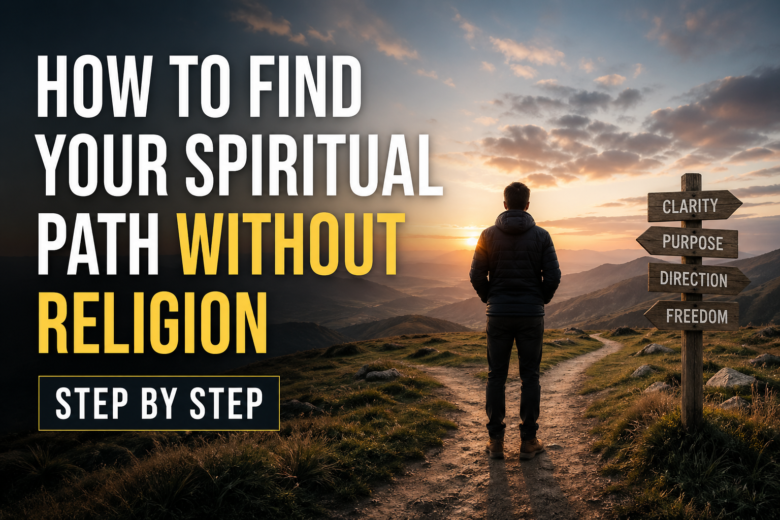
However, this assumption is flawed. A spiritual path is not about belief—it is about orientation. It defines how you understand yourself, how you make decisions, and how you move through life with less confusion. This guide explains how to find your spiritual path without religion step by step, using logic, observation, and real-world application.
What Does a Spiritual Path Mean Without Religion?
Before you can find your path, you need to redefine what the concept actually means.
In a non-religious context, a spiritual path is not a belief system. Instead, it is a functional structure that helps you interpret your internal state, make decisions, and create direction. Every day, you are already doing these things—but often without awareness or consistency.
This lack of structure leads to confusion. People react instead of analyze. They follow patterns without understanding them. Over time, this creates a persistent sense of misalignment.
A practical approach changes this dynamic. Instead of adopting external systems, you build your own internal framework. As a result, spirituality becomes something you can test, refine, and improve—rather than something you must believe.
Why Traditional Spirituality Doesn’t Work for Skeptics
Traditional spirituality often relies on belief, interpretation, and abstract language. While this works for some, it creates friction for skeptical thinkers.
First, belief is usually required upfront. If the foundation is not accepted, everything else feels unstable. Second, many concepts are vague, which makes them difficult to evaluate. Finally, symbolic language adds another layer of ambiguity.
Because of this, the problem is not spirituality itself—it is the format.
A rational approach removes these barriers. It replaces belief with observation, vague interpretation with clear definition, and symbolism with direct language. As a result, the process becomes understandable before it becomes acceptable.
Step 1: Define What You Actually Want
The first step is not about discovering something new. It is about removing interference.
Most people operate based on inherited expectations. Social pressure, cultural norms, and external validation shape what they think they want. Over time, these influences feel personal—even when they are not.
This creates internal friction. Decisions may seem correct externally, but they feel misaligned internally.
To correct this, you need to define your own parameters.
Start by focusing on your daily experience. What kind of mental state do you actually want? Do you prefer clarity over stimulation? Stability over intensity? Autonomy over security?
Then identify recurring friction. What situations consistently drain your energy or create confusion?
Finally, simplify direction. Instead of searching for a grand purpose, define what you want more of and what you want less of.
This step creates a baseline. Without it, any path you attempt to build will lack direction.
Step 2: Build Awareness Without Meditation
Once you define direction, the next step is awareness.
Awareness is often associated with meditation, but it does not require it. At its core, awareness is observation. It is the ability to notice what is happening internally with clarity.
Most people operate with low awareness. They see outcomes but not the processes behind them. For example, they notice stress, but not the sequence that caused it.
To improve this, focus on transitions.
When does your state change? When do you lose focus? When do you become overwhelmed?
Instead of trying to control your thoughts, observe them. Identify triggers, reactions, and decisions.
Short daily reflection can reinforce this. Spend a few minutes reviewing key moments. Over time, this builds a clear map of your internal processes.
Step 3: Identify Internal Patterns and Thought Loops
With consistent observation, patterns begin to emerge.
What seems random at first becomes predictable. Certain situations trigger similar reactions. Certain thoughts repeat and lead to the same outcomes.
These are your internal patterns.
Many people misinterpret these patterns as isolated problems. In reality, they are systemic. The same structure appears across different areas of life.
For example, overthinking may follow a consistent loop: analyzing options, anticipating negative outcomes, delaying action, and defaulting to safety.
Recognizing this pattern changes everything.
Instead of reacting to each situation, you begin to understand the mechanism behind it. This allows you to anticipate and interrupt the pattern before it fully develops.
As a result, control becomes more natural. Not forced, but informed.
Step 4: Create a Personal Framework for Meaning
At this stage, you move from observation to structure.
Meaning is often treated as something to discover. However, a more effective approach is to treat it as something you build.
Meaning emerges from alignment between values, actions, and direction.
To create this alignment, define your core drivers. These are practical preferences that consistently appear in your behavior.
Then connect them to action. If clarity is important, reduce complexity. If autonomy matters, minimize dependency.
This creates a functional framework.
Instead of chasing meaning, you create conditions where meaning naturally appears through consistency.
Step 5: Apply Your Path in Real Life
A framework only works if it is applied.
Each decision becomes a test. Does it align with your structure? Does it increase clarity or create confusion?
These questions generate feedback.
If a decision improves clarity, your framework is working. If it creates friction, something needs adjustment.
Over time, this process refines your system. Decisions become faster and more consistent. Doubt decreases because your criteria are clearer.
This is what a real path looks like: not fixed, but adaptive and functional.
Common Mistakes to Avoid
Even with a structured approach, some mistakes are common.
One is replacing religion with another external system. The goal is not to follow a different framework, but to build your own.
Another mistake is expecting immediate clarity. This process requires iteration.
Overanalysis is also a risk. Awareness without action does not create change.
Finally, complexity can become a trap. A good system should feel simple and usable.
A Simple Daily System to Stay on Your Path
To maintain consistency, you do not need an elaborate routine. What you need is a minimal system that reinforces awareness and alignment.
At the end of each day, take a few minutes to review one or two key decisions. Not everything—just the moments that had the most impact.
Reconstruct what happened. What was the situation, what criteria you used (if any), and what the outcome was. Then evaluate it based on your framework. Did it align, or did it deviate? If it deviated, what was missing?
This process is not about judgment. It is about calibration.
Over time, these small adjustments accumulate. Your framework becomes more precise, your awareness becomes more immediate, and your decisions become more consistent.
The system remains simple, but its effects compound.
Final Thoughts
Finding your spiritual path without religion is not about rejecting meaning—it is about redefining how meaning is created.
When you remove belief as a requirement, what remains is something far more adaptable and grounded. A process based on observation, structure, and iteration. A system that evolves with you, instead of asking you to conform to it.
This approach does not provide absolute answers, and it does not eliminate uncertainty. What it does is change your relationship with both. You move from searching for predefined truths to building functional clarity.
Over time, that shift becomes significant. Not because it leads to a single, final conclusion, but because it gives you the ability to navigate complexity without relying on external validation.
That is what a practical spiritual path looks like. Not something you follow blindly, but something you build, test, and refine—until it works.
Conclusion
A spiritual path does not require belief, tradition, or external guidance. It requires clarity, structure, and a willingness to engage with your own internal processes. By defining what you actually want, building awareness, identifying patterns, and creating a functional framework, you develop a system that guides your decisions in a consistent and practical way.
Instead of searching for meaning in predefined systems, you construct it through alignment and iteration. And in doing so, you create something far more reliable than borrowed beliefs—a path that is not only yours, but one that actually works in real life.
FAQs
1. Can you really have a spiritual path without believing in anything?
Yes. When defined as a system of self-awareness and decision-making, a spiritual path does not require belief—only observation and structure.
2. What if I don’t feel anything “spiritual” during the process?
That is expected. This approach is not based on emotional experiences, but on clarity and functionality. Any sense of depth comes from understanding, not from imposed feeling.
3. How do I know if my path is “correct”?
Instead of correctness, focus on results. If your decisions become clearer and your internal friction decreases, your framework is working.
4. What if my framework keeps changing?
That is part of the process. A functional system adapts over time as your awareness improves.
5. Is this better than traditional spirituality?
Not necessarily better—just more aligned with people who prioritize logic, structure, and independence from belief systems.