Most people are told that exploring their inner self requires belief in something abstract—religion, energy, or a higher force. For a skeptical or analytical mind, this immediately creates friction. It feels ungrounded, unverifiable, and disconnected from how reality is processed on a logical level. As a result, many people disengage entirely from self-exploration, assuming it is not built for them.
But the real issue is not the concept of inner exploration—it is the format in which it is presented. When the process depends on belief instead of understanding, it excludes those who prioritize clarity, structure, and evidence-based thinking. This creates a gap where highly capable individuals remain disconnected from their internal world.
There is, however, a different approach—one that replaces belief with observation and confusion with structure. If you’ve ever felt that traditional paths don’t align with how you think, this framework offers a more precise alternative worth examining.
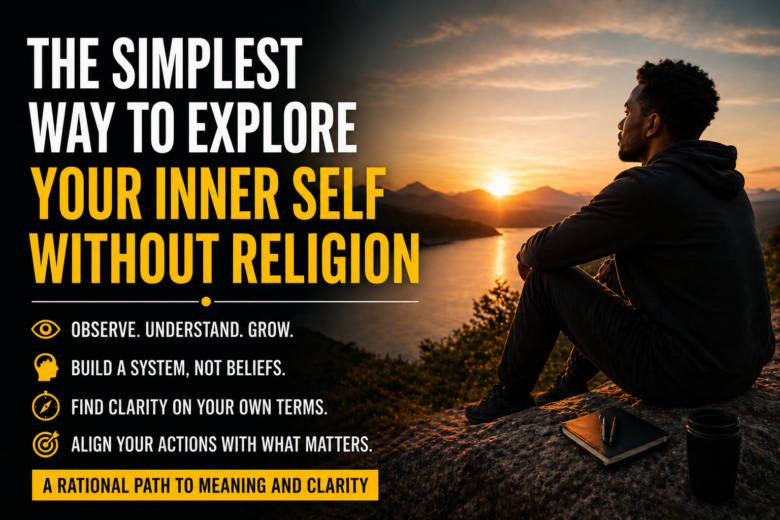
The Simplest Way to Explore Your Inner Self Without Religion
Why Exploring Your Inner Self Feels Difficult Without Religion
The Problem with Belief-Based Systems
Traditional systems rely heavily on belief as an entry point. You are expected to accept certain premises before experiencing any results. For analytical thinkers, this creates resistance. Without initial evidence, engagement feels forced.
This is not a failure of the individual—it is a mismatch in methodology.
Belief-first systems assume that meaning must be accepted before it can be understood. A rational framework reverses this: meaning must be understood before it can be accepted.
The Gap Between Logic and Meaning
Another issue is the disconnect between logical reasoning and personal meaning. Many people assume that logic eliminates depth. In reality, it refines it.
When meaning is not grounded in clarity, it becomes unstable. When it is built on structured observation, it becomes usable.
This is where most people get stuck—not because they lack introspection, but because they lack a system.
The Simplest Way to Explore Your Inner Self Without Religion
Reframing Self-Exploration as a System
The simplest way to explore your inner self without religion is to treat it as a system rather than a belief.
A system can be observed, tested, and improved. It does not require faith—it requires attention.
Instead of asking “What should I believe?”, the question becomes: “What is actually happening inside me, and how does it influence my behavior?”
This shift changes everything.
Shifting from Belief to Observation
Observation removes ambiguity.
Rather than interpreting emotions symbolically, you analyze them functionally. Instead of searching for meaning, you identify patterns.
This creates a feedback loop: observe → understand → adjust.
Over time, clarity replaces confusion—not because you found answers, but because you built a process.
Step 1: Reduce External Noise
Identifying Influences
Your internal state is not entirely yours.
Social expectations, cultural narratives, and digital environments constantly shape your thinking. Most of this happens passively.
To explore your inner self, you must first identify these influences.
Ask yourself: which thoughts are genuinely yours, and which are inherited?
This distinction is often uncomfortable—but necessary.
Creating Mental Space
Once identified, reduce exposure where possible.
This does not mean isolation. It means intentional consumption.
Limit inputs that create confusion or comparison. Replace them with silence or neutral environments.
Clarity requires space. Without it, internal signals remain distorted.
Step 2: Observe Without Judgment
Understanding Thought Patterns
Most people try to control their thoughts before understanding them.
This is inefficient.
Observation comes first. Notice recurring thoughts, emotional triggers, and reactions. Document them if necessary.
Patterns will begin to emerge.
Separating Reaction from Reality
A key distinction: not everything you feel reflects reality.
Emotions are responses, not facts.
When you observe without judgment, you create distance between stimulus and reaction. This distance is where clarity develops.
Step 3: Map Your Internal Patterns
Identifying Repeating Loops
What appears random is often predictable.
You may notice cycles: overthinking before decisions, avoidance under pressure, or impulsive reactions in uncertainty.
These are loops—not isolated events.
Once identified, they become easier to interrupt.
Predicting Behavior
Prediction is a powerful tool.
If you know how you tend to react, you can anticipate it.
This transforms self-awareness into self-regulation.
You are no longer reacting—you are navigating.
Step 4: Define Your Personal Values Logically
Values vs Preferences
Many people confuse values with ideals.
Values are not what sounds good—they are what consistently drives your decisions.
Look at your behavior, not your intentions.
What do you prioritize under pressure? That is closer to your real value system.
Building a Functional Value System
A functional system is simple and actionable.
Instead of abstract values like “freedom,” define what it means operationally.
For example: freedom = control over time allocation.
This makes alignment measurable.
Step 5: Align Decisions with Internal Clarity
Decision Filters
Every decision either increases clarity or creates friction.
Use your values and patterns as filters.
Before acting, ask: does this align with my system?
If not, why?
This process reduces impulsive decisions.
Reducing Internal Conflict
Conflict often comes from misalignment.
When your actions contradict your internal structure, tension increases.
Alignment reduces this tension—not by eliminating difficulty, but by making direction clearer.
Common Mistakes to Avoid
One common mistake is replacing religion with another rigid system.
The goal is not substitution—it is autonomy.
Another mistake is overanalysis without action.
Insight without application creates stagnation.
Finally, complexity can become a distraction.
If your system is too complicated to use daily, it will fail.
A Minimal Daily Practice for Long-Term Clarity
You do not need an elaborate routine.
At the end of each day, review one decision.
Analyze what influenced it, how it felt, and whether it aligned with your system.
This creates continuous refinement.
Over time, small adjustments lead to significant clarity.
Conclusion
The Simplest Way to Explore Your Inner Self Without Religion is not about rejecting depth—it is about restructuring how depth is accessed.
By replacing belief with observation and abstraction with systems, you create a framework that evolves with you. This approach is not static. It adapts as your understanding grows, making it both practical and sustainable.
Clarity is not something you discover fully formed. It is something you build, test, and refine over time. And once you understand that, the process becomes less about searching—and more about constructing something that actually works.
FAQs
1. Can you explore your inner self without any belief system?
Yes. A structured, observation-based approach allows self-exploration without relying on belief.
2. Is this method better than traditional spirituality?
It depends on cognitive preference. This method aligns better with analytical thinkers.
3. How long does it take to gain clarity?
Initial insights can happen quickly, but long-term clarity develops through consistent practice.
4. Do you need journaling for this process?
No, but it can accelerate pattern recognition and awareness.
5. What is the biggest challenge in this approach?
Maintaining consistency without overcomplicating the system.