
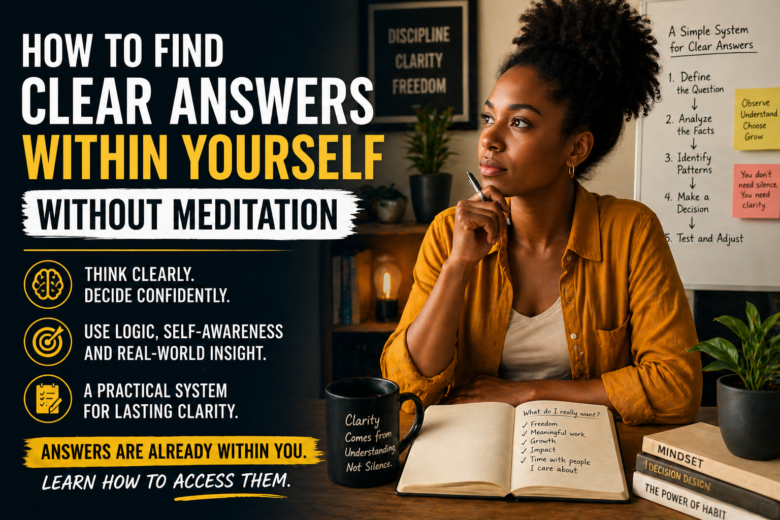
For years, meditation has been positioned as the default method for gaining clarity. If you feel lost, overwhelmed, or uncertain, the common advice is simple: sit still, breathe, and wait for answers to emerge. But for many people—especially analytical thinkers—this approach feels ineffective. The mind does not quiet down. Instead, it becomes louder, more chaotic, and harder to navigate.
This creates a frustrating paradox. You are told that clarity comes from silence, yet your experience suggests the opposite. Instead of gaining answers, you feel stuck in loops of overthinking or distraction. The issue is not a lack of discipline—it is a mismatch between method and mindset.
There is another way to approach this problem. How to Find Clear Answers Within Yourself Without Meditation is not about rejecting introspection—it is about restructuring it into something active, logical, and usable. If you prefer clarity through understanding rather than stillness, this framework offers a different path worth examining.
How to Find Clear Answers Within Yourself Without Meditation
Why Meditation Doesn’t Work for Everyone
The Expectation Problem
Meditation is often framed as a universal solution. The assumption is that stillness leads to clarity. However, this only works for certain cognitive styles.
If your mind processes information through analysis, removing input does not automatically create insight. Instead, it can amplify unresolved thoughts.
The expectation that silence equals answers becomes misleading.
Passive vs Active Clarity
Meditation is largely passive. It creates space but does not structure thought.
Clarity, on the other hand, often requires active engagement—questioning, analyzing, and organizing information.
For many people, clarity is not discovered in silence. It is constructed through deliberate thinking.
How to Find Clear Answers Within Yourself Without Meditation
Reframing Clarity as a Process
Clarity is not a moment of realization. It is a process.
When you treat it as a system, you remove randomness. Instead of waiting for insight, you generate it.
This approach is more reliable because it is repeatable.
Moving from Stillness to Analysis
Instead of trying to stop your thoughts, use them.
Direct your thinking toward specific questions. Break down complexity into smaller parts.
Analysis transforms confusion into structure.
Step 1: Define the Question Precisely
Avoiding Vague Thinking
Most confusion starts with vague questions.
“What should I do with my life?” is too broad to answer effectively.
Clarity requires precision.
Refine the question: “What type of work environment increases my focus and reduces stress?”
This makes the problem solvable.
Structuring Internal Questions
A useful technique is constraint-based questioning.
Define variables: time, energy, priorities.
This limits the scope and forces specificity.
The clearer the question, the clearer the answer.
Step 2: Separate Emotion from Information
Emotional Noise vs Signal
Emotions are data—but not always accurate.
They indicate that something matters, not necessarily what is true.
If you treat emotions as facts, your conclusions become distorted.
Recognizing Cognitive Distortion
Learn to identify patterns like catastrophizing or overgeneralization.
Resources like https://www.psychologytoday.com explain these distortions in detail.
Separating emotion from information allows you to analyze situations more objectively.
Step 3: Analyze Patterns Instead of Moments
Looking at Repeated Behavior
Single events are misleading.
Patterns reveal truth.
If you consistently avoid certain situations, there is a structural reason behind it.
Predictive Self-Understanding
When you identify patterns, you gain predictive power.
You can anticipate reactions and adjust before they happen.
This shifts you from reactive to proactive thinking.
Step 4: Create a Decision Framework
Criteria-Based Thinking
Decisions become easier when criteria are defined.
For example: clarity, autonomy, long-term benefit.
Evaluate each option against these criteria.
Reducing Uncertainty
Uncertainty decreases when decisions follow a structure.
Instead of guessing, you compare.
This makes outcomes more consistent.
Step 5: Test and Adjust in Real Life
Feedback Loops
Every decision provides feedback.
Did it reduce confusion or increase it?
Use this data to refine your framework.
Iteration Over Perfection
Clarity evolves.
You do not need perfect answers—only better ones.
Iteration ensures continuous improvement.
Common Mistakes to Avoid
One mistake is overthinking without structure.
Analysis should simplify, not complicate.
Another is ignoring emotional input entirely.
Balance is key.
Finally, expecting instant clarity leads to frustration.
This is a process, not an event.
A Simple Daily System for Clear Thinking
At the end of the day, review one decision.
Ask: what influenced it? What was the outcome?
Over time, patterns emerge.
This builds clarity incrementally.
Conclusion
How to Find Clear Answers Within Yourself Without Meditation is not about eliminating introspection—it is about making it functional.
By replacing passive methods with active analysis, you create a system that consistently produces clarity. This approach aligns with how analytical minds naturally operate, making it both practical and sustainable.
Instead of waiting for answers, you generate them. And once you understand that clarity is built—not found—you gain control over the process.
FAQs
1. Can you gain clarity without meditation?
Yes. Structured thinking and analysis can replace passive methods.
2. Is this method better for analytical people?
Yes. It aligns with logic-based processing styles.
3. How long does it take to see results?
Initial clarity can appear quickly, but refinement takes time.
4. Do emotions still matter in this approach?
Yes. They are data, but must be interpreted carefully.
5. What is the biggest advantage of this method?
Consistency. It creates repeatable clarity instead of relying on chance.