
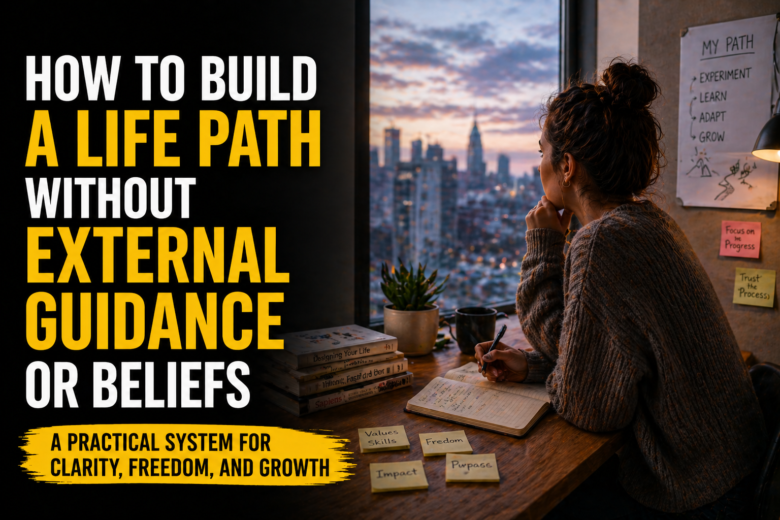
There is a growing number of people who no longer rely on traditional sources of direction. Religion, rigid career paths, and predefined life scripts once offered a sense of clarity. Today, many individuals question these structures, not out of rebellion, but out of a need for coherence that aligns with logic and personal experience.
Without those external frameworks, something subtle happens. You gain freedom, but you also inherit responsibility. Decisions are no longer guided by inherited systems. Instead, you are left to define direction on your own, often without a clear method for doing so.
Understanding How to Build a Life Path Without External Guidance or Beliefs is not about replacing one belief system with another. It is about creating a structure that allows direction to emerge from your actions, your observations, and your ability to refine both over time. If you have ever felt capable but uncertain about where to apply that capability, this is where that uncertainty begins to transform.
Why Modern Individuals Struggle Without Guidance
The modern environment is defined by optionality. You can choose almost any path, shift careers, redefine your identity, and access endless streams of information. While this seems empowering, it introduces complexity that the human brain is not naturally equipped to handle.
When choices multiply, clarity decreases. Each option carries uncertainty, and without a way to evaluate them effectively, decision-making becomes unstable.
This instability is often interpreted as indecision or lack of discipline. In reality, it is a structural problem. You are operating in an environment that offers more possibilities than your cognitive system can easily organize.
Without a framework, your attention becomes fragmented, and your sense of direction weakens.
The Collapse of Traditional Direction Systems
For most of human history, direction was inherited. Social roles, cultural expectations, and institutional structures provided a predefined path. You did not need to design your life—you followed it.
Today, those systems have weakened. People question authority, reject rigid expectations, and prioritize autonomy. This shift has removed constraints, but it has also removed guidance.
The result is not confusion by accident. It is confusion by design.
When external systems disappear, the responsibility for structure moves inward. Without replacing that structure, the system collapses into ambiguity.
Why Advice Based on Belief Systems Fails
Much of the existing advice on life direction is still rooted in belief-based frameworks. You are told to trust the universe, follow your intuition, or align with something intangible.
For individuals who prioritize evidence and logical consistency, this advice lacks operational clarity. It does not explain how to evaluate decisions or measure progress.
When internal signals are unclear, this approach creates more doubt than confidence.
The issue is not that belief systems are inherently wrong. It is that they are not universally applicable. Without a way to test and refine decisions, they cannot support consistent direction.
Reframing Direction as a Constructed Process
Direction is often treated as something you discover. This creates a passive mindset where you wait for clarity to appear.
A more effective approach is to treat direction as something you construct.
Construction requires interaction. You take action, observe outcomes, and adjust based on feedback. Over time, patterns begin to emerge.
These patterns provide clarity. Not because you found the right answer, but because you built a system that produces it.
This shift changes the entire process. You stop searching and start designing.
How to Build a Life Path Without External Guidance or Beliefs: A Practical System
At its core, How to Build a Life Path Without External Guidance or Beliefs is about creating a feedback-driven system.
You begin by choosing a direction that is not perfect, but actionable. The goal is not certainty. The goal is movement.
Once you act, reality responds. Results appear. Some actions create progress, others create friction. This feedback is the raw material of direction.
Instead of interpreting results emotionally, you analyze them. You identify patterns, refine your approach, and move forward again.
Over time, this cycle produces clarity that cannot be achieved through thinking alone.
Internal Variables: Values, Attention, Identity
Three internal variables shape how your path develops.
Values determine what you prioritize. They filter your decisions and influence what outcomes feel meaningful. Without clear values, all options appear equally uncertain.
Attention controls where your energy goes. If your focus is scattered, your results will be inconsistent. Concentrated attention creates stronger feedback loops.
Identity influences behavior. If your sense of self is unstable, your actions will lack consistency. As your identity aligns with your actions, your direction becomes more stable.
These variables are not static. They evolve as you interact with your environment.
Action, Feedback, and Iteration
Direction becomes tangible through repetition. Each action produces feedback, and each piece of feedback informs your next step.
In the middle of this process, How to Build a Life Path Without External Guidance or Beliefs becomes practical. You are no longer trying to solve your entire life at once. You are solving the next step, then adjusting based on what happens.
Iteration reduces uncertainty. Instead of guessing, you are learning.
Over time, this creates momentum. Momentum reduces hesitation, making it easier to continue.
Designing a Personal Direction System
A personal system does not require complexity. It requires consistency.
You define a short-term direction and commit to it for a fixed period. During this time, you focus on action rather than evaluation.
Once the period ends, you analyze the results. You identify patterns, refine your approach, and choose the next direction.
This process creates a loop. Each cycle improves your understanding, making future decisions clearer.
The system becomes self-correcting.
Environmental Influence on Your Path
Your environment affects your ability to build direction. Too many inputs create noise. Noise makes it difficult to interpret feedback.
Simplifying your environment increases clarity. When variables are reduced, patterns become easier to identify.
This does not mean isolating yourself completely. It means being intentional about what you consume and where you invest your attention.
A structured environment supports a structured process.
Cognitive Traps That Disrupt Progress
Certain mental patterns interfere with this system.
Overthinking delays action. Without action, there is no feedback. Without feedback, there is no clarity.
Comparison introduces irrelevant variables. Measuring your path against others distorts your perception of progress.
Inconsistency prevents patterns from forming. Without repetition, your system cannot stabilize.
Recognizing these traps allows you to design around them.
Long-Term Stability Without External Validation
As your system matures, something shifts. You begin to rely less on external validation and more on your own observations.
Decisions become clearer because they are based on accumulated experience. You develop internal stability.
At this stage, How to Build a Life Path Without External Guidance or Beliefs is no longer a concept. It becomes a method you apply automatically.
Direction is no longer something you question constantly. It becomes a byproduct of how you operate.
Conclusion
Building a life path without external guidance is not about removing structure. It is about creating your own.
When you shift from searching for direction to constructing it through action and feedback, clarity becomes something you generate. This is the foundation of How to Build a Life Path Without External Guidance or Beliefs.
You do not need certainty to begin. You need a system that allows clarity to emerge.
Over time, that system becomes your direction.
FAQs
1. Is it possible to build a life path without any guidance?
Yes. With a structured system based on action and feedback, direction can emerge naturally.
2. Why do I feel lost without external systems?
Because those systems previously provided structure. Without replacing them, uncertainty increases.
3. How do I choose a direction without certainty?
Choose a direction that is actionable and refine it based on feedback.
4. Can I rely only on logic to build direction?
Logic helps structure decisions, but experience provides the data needed for clarity.
5. How long does it take to build a clear path?
It depends on consistency, but patterns can begin forming quickly with repeated action.